We are lead to believe that love is fleeting. I reckon, when you get a little older, and your boat gets batted around a bit, you realize that love is really more a decision. And, it's an opportunity to exist with somebody at their best, and at their worst. And, in doing so, the reflections that you get in one another become the scars that you covet, because those are those simple secrets that are yours alone. And those things are not celebrated in 'movie love.' That's the real stuff that we all fear, that I think is easy to walk away from... ...Their journeys come with their bumps and bruises. And, I think that if you are of a mind that will ultimately celebrate those bumps and bruises, even though they might be years in the making, they will be the things you celebrate, that you cherish, and will be the character of your relationship.
This will be my (embarrassingly) self-indulgent clearing house of all things related to swooning, crushes, attempts at dating, and the whole gamut in between, that leave me (a trans-guy) stumped and baffled. I will try to refrain from making gross generalizations about men vs women, and just stick to what I know – which apparently isn't very much anymore.
Monday, February 15, 2010
The Finest Worksong
Sunday, February 14, 2010
Thursday, February 11, 2010
McQueen
(The above title is a clickable link to the British article about the passing of fashion legend Alexander McQueen.)
I was deeply saddened today when I heard about the news of (Lee) Alexander McQueen's suicide, just days after his beloved mother passed away. Despite not following his career closely, I got the impression that we was somewhat of a savant in the fashion world. He changed the scope of fashion design, and even the production value of the shows themselves. His immense talent catapulted him to the upper echelons of the design houses, as he formed his own brand, and even took over as head designer at Givency. Pretty remarkable for someone so young.
But McQueen's fashion shows depicted his often tumultuous moods, and a dark, sombre tone that overshadowed the buoyancy of some of his peers' exhibitions. He was *serious* – and serious about fashion.
Wednesday, February 10, 2010
Snoverkill!

(This is a pic from the last snow storm we had, where people were leaving items in the street to save the parking spots they had just dug out. This was my favorite!)
Okay, I'm getting a little tired of being tired. This never ending snow storm is starting to exhaust me. Several days ago we got about 2' of snow – this after getting about 8" of snow the week before that, and apparently chewed through $2.4 million of DC's $2.6 million snow removal budget. So, the snow we got several days ago still remains packed on our streets, now the foundation of last night's additional 10" of snow. It's still going. Ugh! I have lost a few thousand dollars of missed income, since my business is somewhat dependent on weather, like when the government shuts down, and all of our clients are told not to leave their house. Umm...
Not only that, but I just purchased a Macbook Pro, and it's stuck in a FedEx truck circling the metro area, unable to deliver since the roads are so bad. AHHHHH! Kill me now! Why is this city so incompetent? I grew up in New England, even spent 7 years on and off in Vermont, where it snows like 9 months out of the year, and only once did I miss school/work because of the weather. (In my defense, I was driving my then girlfriend's rear wheel drive Ford Explorer, sans 4 wheel drive, and went careening into a ditch on campus when I hit a patch of ice. Awesome!)
AND, the ceiling in my bedroom is leaking in two places, (still – after recently being patched and sealed twice). I've been watching the news reports of all of these roofs collapsing around the Mid-Atlantic region. So, scary! (As I wrote that, my landlord called to check in about the leaks. Wow, impeccable timing!)
I've been trying to stay productive and positive. Trying to keep busy, writing like crazy, watching a ton of good films, a few books I am hoping to crack today, finish my taxes once and for all, and work out ~ which is long overdue. But first, I am going to go make some corn muffins, as I am running out of food in my house, and it's seriously a "white out" outside! Yikes!
Hoping this finds you well, safe, warm and dry! From the front lines of fighting cabin fever ~ Will (-work for food...)
Monday, February 8, 2010
Playa Hater
So, without sounding like a jerk – I don't understand being a player. I mean, I understand when people need to not have strings attached, or when they want to go into something without projections of it having to be everything. Sure, that I understand. But...
A friend of a friend recently got dumped. From what I understand, the dumper sort of gave the dumpee's friends a heads up that he needed to get his shit together, or it wasn't going to work out. This after she (the dumper) repeatedly tried to talk some sense into him (the dumpee). With no avail, she needed to move forward, and cut the cord.
As I mentioned, these are not immediate friends of mine, so it was a relationship I knew nothing about directly. And without placing judgment, I simply don't understand. The guy who was dumped is already out scouting new prospects, while simultaneously rambling endlessly about his recent ex. I just don't get it. I'm in my mid 30's (turning 35 at the end of this year ~ holy fucking shit!!!), and maybe I'm too sentimental, but I can't imagine ending a super long term live in relationship, and even joking about going out to hook up with other chicks. (And yes, in my youth, I was not so great with fidelity, but now that I'm 'over the hill,' it just seems so exhausting.
Maybe this is why I'm taking a hiatus from dating. Is there like a pill form of 'No Doze' specifically for relationships? I think that's what I need now. I'm not a playa, I just crush a lot. (But maybe not as much as my heartbroken counterparts.)
Sunday, February 7, 2010
The Id vs the Superego = Cognitive Dissonance
I've been thinking about that last post, reflecting on that struggle between pure, unfiltered desire, versus self-censoring critique, bordering on condemnation. The Id duking it out with the Superego, yet in the above image, I'm not sure which would which... (I simplistically assume the inflatable weeble punching bag would be the Id. Maybe it's cuz it has that goofy grin on its face, that makes you wanna punch it. Although in my case, I think the Superego mostly wins the battles.)
The Id can be described as the infantile, narcissistic pursuit we have to seek out constant gratification. This is the underlying drive we have for survival, things we crave, like affection, sex, nourishment, intoxicants, etc. It's also been called "the Pleasure Principle," like Janet Jackson sang about in the late 1980s. (I didn't realize how 'deep' she was back then, especially considering that I was in sixth grade when that song came out. I hadn't read Freud for myself yet. That didn't happened until I was in junior high school, and started paging through Freud, Jung, Goethe, Schopenhauer for extra curricular reading... God, I've always been such a dork, haven't I?!?)
In addition to the Id, Freud believed there was what he called "the Superego," which was basically what we'd deem 'the conscience,' or the moral code by which we judge things. It's that little voice inside our head that tells us what the 'right' thing to do is in a given situation. (Or that cartoon angel on our shoulder, while the Id would be the devil, tempting us to satiate all of our secret urges.)
The Superego's self-critic is almost always in direct opposition to those lustful, carnal cravings the Id desires. Freud went on to say that it is the job of "the Ego" to keep those two elements of self in check. The Ego is the rational facet of our psyches that tries to weigh the cost benefit analysis, and proceed with the more moderate decision.
When there is a conflict between what we crave and what we think we 'should' want or do, cognitive dissonance emerges. The tension itself increases depending on how important that subject is to an individual, how drastically different the 'wants' are from the 'should want instead,' and if we can't rationalize away the differences between the two. Often times, the greatest sense of dissonance arises when we are talking about one's own self image, when we have acted in a way that goes against how we generally see ourselves. If we've already made a decision, and are feeling regretful over the course we took, that dissonance tends to surface in the form of guilt, feeling foolish, or even immoral.
The ways in which we can reduce those tensions are to a) change our initial belief, b) change the related decision/action/behavior contrary to that initial belief, or c) rationalize away the difference between the belief and the resulting action. But if that internalized conflict is not resolved swiftly, a feeling of anxiety usually begins to set in. Freud categorized three basic types of anxiety: reality (based on real or possible event), neurotic (based on a fear that we have no control – or metaphorically, that our Id will take over), and morality (based on a fear that we've violated our moral code – which tends to bring up guilt or shame).
Theoretically it seems easy enough to make a shift in our thoughts or behaviors, but many times it can be a bigger task than we could imagine, or even feel absolutely excruciating. That uncomfortable emotional space of dissonance can often trigger our unconscious defense mechanisms. Freud believed that there were many ways that defense mechanisms could manifest (as cited by changingminds.org):
- Denial: claiming/believing that what is true to be actually false.
- Displacement: redirecting emotions to a substitute target.
- Intellectualization: taking an objective viewpoint.
- Projection: attributing uncomfortable feelings to others.
- Rationalization: creating false but credible justifications.
- Reaction Formation: overacting in the opposite way to the fear.
- Regression: going back to acting as a child.
- Repression: pushing uncomfortable thoughts into the subconscious.
- Sublimation: redirecting 'wrong' urges into socially acceptable actions.
Huh, that's a lot of 'schtuff' to wade through... So, is there anything left that Freud didn't cover?!? I feel like this is just one big check list, like "Yep, I do that – ya, that one, too... Ooooh, and that one should probably be on my list, even though I wish it wasn't." Oooof! Some food for thought, egh?
When I look closely at this list, and the ideas mentioned above, I see that (based purely on a Freudian analysis of my current status) I've got some stuff to work out. (Of course there have been a zillion more theories and practitioners that have come and gone since then, so I'm not sure why I am fixating on Freud alone... Do I need to over-analyze my attraction to Freud right now? Some dumb ass meta-narrative?!? But anyway...)
It all comes down to this: Even when we recognize these patterns – when we can identify, quantify, and understand the roots of our issues – what does it take to change the direction of our lives? *Knowing* is not enough. There has to be a catalyst, an epiphany, that realization calling us to a higher plane of knowledge. Enlightenment seems too strong of a word here, but along those lines. A call to action, a motivation to engender this new refined understanding. But I feel stuck, not able to fully realize my greatest potential. There is a catch, but while trying to free myself from that snag, I have seemingly gotten myself further entangled, tripping on my own rip cord.
I had a Latin teacher in high school that used to say: "It's not freedom from, but rather, freedom to ___." I think I am finally understanding the gravity of that sentiment. Unfortunately, I still don't feel free quite yet. (sigh~)
Saturday, February 6, 2010
Art of Manliness: Avoiding Learned Helplessness


(Click on the title, and it will link you to the full article on The Art of Manliness website.)
The Art of Manliness recently posted an interesting article about: "Boosting Your Resiliency-Part 2: Avoiding Learned Helplessness and Changing Your Explanatory Style." It seemed like a good idea to revisit some of those passages now that I am homebound and restless in this blizzard.
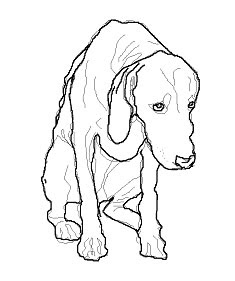
In 1967, Dr. Martin Seligman began his social experiments focusing on learned helplessness. These experiments (unfortunately) began with three groups of canines, two of which would receive mild shocks to test their capacity for resilience, and their abilities to modify their behaviors in such a way that it would allow them to escape the shocks, while the third was the control group, receiving no shocks at all.
The first group of dogs were given electric shocks, but were able to press a panel with their nose to make the shocks stop. The second group of dogs were given the shocks as well, but had no recourse to make them stop. The third group was the control and received no shocks.The dogs in the first and third group recovered well from the experiment. But the dogs in the second group, those that had been helpless to stop the pain, developed symptoms similar to clinical depression.
In the second part of the experiment, the dogs were placed in an enclosed box separated by a low barrier over which they could see. When the shocks were administered, all the dogs had the opportunity to easily escape the pain by jumping over the partition, and this is what the dogs in the first and third group did. But the dogs in the second group, those which had previously learned that there was nothing they could do to escape the shocks, simply lay there whimpering and took it. They had come to believe that nothing they did mattered; Dr. Seligman called this behavior “learned helplessness.”
The experiment was repeated with other animals, babies, and adult humans, and the results were the same. Once subjects had been exposed to a situation over which they had no control, they would continue to feel helpless, even in situations where they *did* have control.
Explaining Explanatory Style
Dr. Seligman discovered that the difference between those who were able to bounce back and those who were susceptible to learned helplessness was rooted in the different ways people explain the things that happen to them.
Seligman argues that our interpretation of events can be broken down into three categories:
- Personalization (internal vs. external)
- Pervasiveness (specific vs. universal)
- Permanence: (temporary vs. permanent).
The authors of The Resilience Factor helpfully rename these categories in an easier to remember way and explain their meaning:
- Me/Not Me
- Always/Not Always
- Everything/Not Everything:
“A ‘Me, Always, Everything’ person automatically, reflexively believes that he caused the problem (me), that it is lasting and unchangeable (always), and that it will undermine all aspects of his life (everything). When problems arise, a “Not Me, Not Always, Not Everything person believes that other people or circumstances caused the problem (not me), that it is fleeting and changeable (not always), and that it will not affect much of his life (not everything).”
For obvious reasons, studies have shown that those with a “Not Me, Not Always, Not Everything” explanatory style are the most optimistic, while those with a “Me, Always, Everything” explanatory style are prone to pessimism and depression. Once MAE’s fail at something, they are susceptible to experiencing “learned helplessness” for a long time and across many areas of their life.
The effect of your explanatory style not just on your resiliency but on your whole life cannot be overstated. Those with a pessimistic, “Me, Always, Everything” explanatory style are more prone to depression, anxiety, low self-esteem, and paralyzing inertia in the face of setbacks. Those with an optimistic, Not Me, Not Always, Not Everything style, on the other hand, experience improved health and happiness and significantly more success in the workplace, at school, and on the playing field.
It's tough to be reminded that the way that we think about the world is *not* objective. In reality, it's a series of unconscious or subconscious choices we repeatedly make to affirm our role within the world at large. Sure, it could be incredibly liberating to read about studies such as this, and simply recognize that we are the result of our own unwitting social experiments – individuals that theoretically *could* continue to modify our psychological makeup, our perceptions and related behaviors, into a better life, but... Not being world renowned social scientists ourselves, how do we delve in to our own psychological programming to debug our systems, and embark on a metapersonality upgrade?
Neuropsychiatrist, Dr. Daniel Amen, refers to debunking our learned helplessness by fighting what he termed the "A.N.T.'s," Automatic Negative Thoughts. He believes that if we can consciously train ourselves to question, and therefore nullify, the negative thoughts that surface in that cycle of learned helplessness, then we can often spring ourselves from the confines of our own sabotaging anxiety and depression. (To be noted: Dr. Amen does believe that there are both genetic and environmental roots to anxiety disorders and clinical depression that are very real, and need to be addressed biochemically – so please don't think he went all Tom Cruise on our asses, and is telling us to "turn that frown upside down" in place of the meds that signal relief for the millions suffering with those conditions.)
There is a term in developmental psychology for that subconscious stream of chatter that we hear inside our head – the one that often seems to be the wizard behind the magical curtain in our mind – it is called "the tapes." These "tapes" seem to play on repeating loops, affirming and confirming the ways we perceive the outside world, and our usefulness, productivity and projected success within that scope. Again, the theory stands that if we can derail negative tracks of this looping tape within our mind, we can free ourselves of the tethers which hold us back, or taint our most earnest efforts.
So many different people hitting that same metaphorical nail on the head: "change your mind to change you life." Okay, it sounds easy enough! Stop *believing* that every thought that floats through my head is 'true.' Remember how much my *perceptions* color the 'objectivity' of a given situation or scenario. Be more discerning while reviewing these perceptions, and toss away the negativity that holds me back unsympathetically. Right. I can do that. Or at least try my darnedest.
Theoretically, living without the burden of that crushing self-criticism would free me up to explore all of the adventures I talk myself out of when stuck in the rut of seeing my life as a tally of defeats and screw ups. But... While trying to fight the inertia, the pinching self-critic, the seemingly fatal flaws that keep me feeling immersed within my youthful folly – I wonder: What are the exercises to train myself into being a more fully realized, and organically capable, successful person?
Now that I know what *not to do,* even if I make that into a 'to do' list – what are the social experiments that I can administer to myself in order to craft this new resilient super human? Anyone??? I suppose this very question lays at the foundation for groups like the aforementioned Scientology, and other such organizations claiming to be the key to realize the individual's fullest potential. (Eek!) Can't I just keep a journal, or do some push ups?!?
Two weeks ago I came up with an idea for this blog, a new series called "Dare (Will) to Dream," in which I ask many of my closest friends to dare me into having a richer life. (It could be amazing, or the most ridiculously lame idea ever fathomed... Maybe I've just watched "Yes Man" too many times on cable.) But after re-reading this Art of Manliness article, maybe it's just what I need to combat the wintertime inertia that has slowed me down, as of late.
I think of my abused pit bull that I rescued years back, desperately needing to be "reprogrammed" after his rough puppyhood. Or my dear 3 legged dog friend Aubrey, who despite his hardships, always seems upbeat and chipper. (So, do I need to sever off one of my own limbs to get a case of the giggles?!? Hopefully not...)
If helplessness can be learned, so can its opposite. I am ready to dare myself into a new perspective for a new resiliency to take root. Go on, dare me – I dare you to...